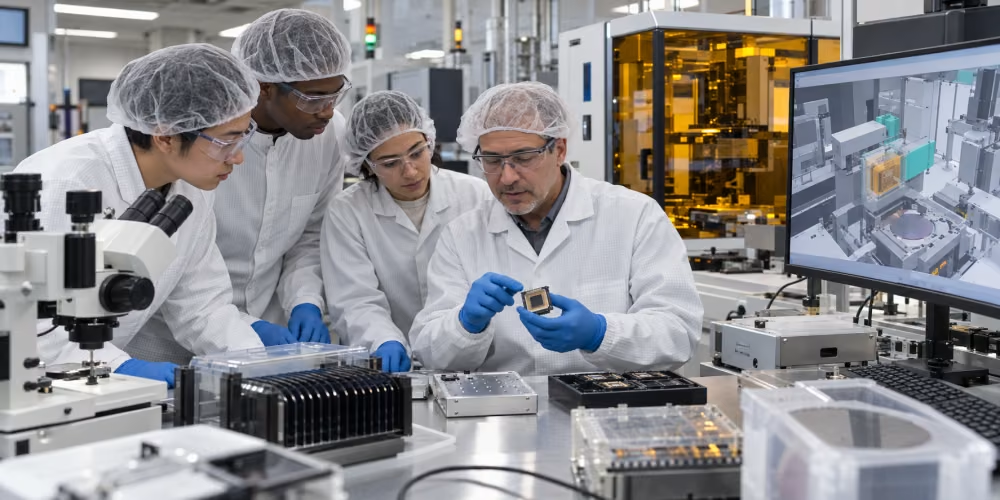
The regional initiative will use AI, digital twins, and shared technical facilities to prepare workers for advanced packaging, photonics, and electronics production.
The SMU-led Texoma Semiconductor Tech Hub plans to dedicate $6 million to workforce education and training across North Texas and southern Oklahoma. The investment is part of a nearly $29 million funding package announced Oct. 23, including an intended $24 million award from the U.S. Economic Development Administration and $4.8 million from additional sources.
The training initiative will use artificial intelligence and digital-twin technologies to help workers build skills for emerging semiconductor needs, including advanced packaging and photonics. Digital twins, which are virtual models of equipment or production environments, can give learners a controlled setting in which to understand processes and practice decisions before working with complex manufacturing systems.
Training will be supported by a broader investment in shared semiconductor infrastructure. The Tech Hub plans to develop modular prototyping facilities, called “fablets,” where researchers, businesses, and learners can access equipment for electronic design, semiconductor manufacturing, packaging, and testing without the cost of building a complete cleanroom.
That connection between instruction and equipment is especially important for technician preparation. Semiconductor employers need workers who understand safety, process discipline, quality requirements, automation, and the interaction between multiple production steps. Applied training can help translate those expectations into practical experience.
The regional structure may prove just as valuable as the technology. The Tech Hub spans 29 counties and includes more than 95 organizations from industry, education, workforce development, government, and economic development. That network gives training providers a way to align programs with employer needs while creating pathways for students, incumbent workers, and people entering advanced manufacturing from other fields.
For electronics manufacturers and workforce partners, the takeaway is clear: training capacity must grow alongside production and research infrastructure. Investments that connect modern instructional tools, shared equipment, and employer input can help regions prepare workers for the increasingly specialized demands of U.S. semiconductor manufacturing.
Source note
The post is based on the U.S. Economic Development Administration announcement(Opens in a new tab/window), Southern Methodist University’s funding summary(Opens in a new tab/window), and the North Central Texas Council of Governments release(Opens in a new tab/window).