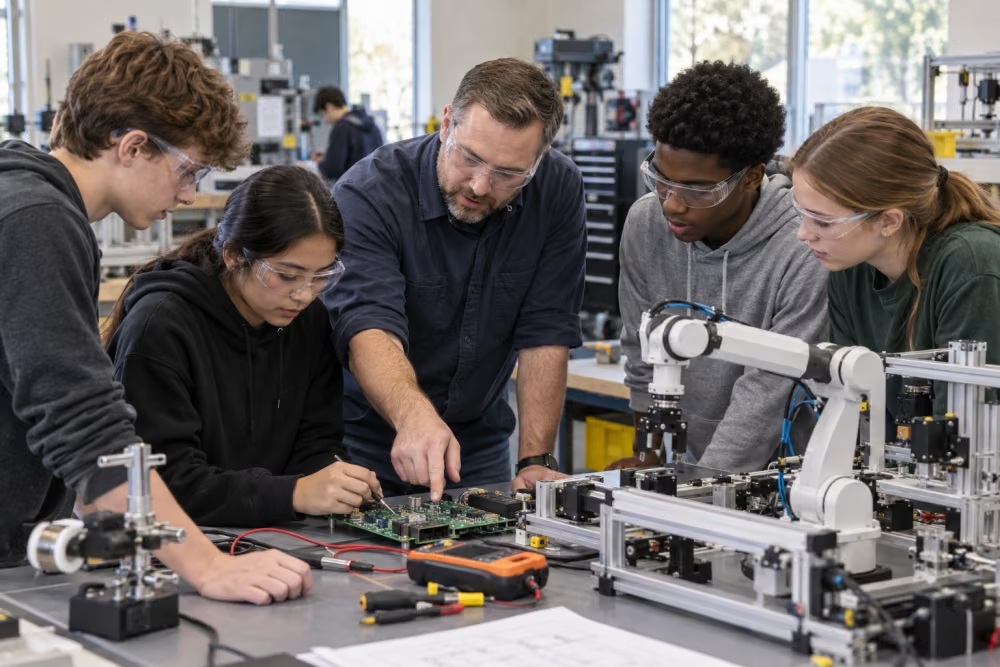
A three-year education initiative will give more students early exposure to the technologies and career pathways shaping U.S. electronics manufacturing.
Intel Foundation and Project Lead The Way are expanding access to semiconductor and advanced-manufacturing education in U.S. schools. Announced September 1, the collaboration centers on a new year-long Advanced Manufacturing course that connects classroom instruction with technologies used across modern production environments.
Supported by a $3 million Intel Foundation grant, the initiative is expected to reach more than 140,000 students and train 1,100 educators over the next three years. The course introduces students to automation, robotics, semiconductor manufacturing, artificial intelligence, cybersecurity, connected systems, digital twins and smart-factory operations.
The partnership also includes school grants and educator support, along with a forthcoming interactive lab that will introduce younger students to chip fabrication, materials science and semiconductor careers. Together, these elements are designed to build awareness well before students choose a college program, technical credential or apprenticeship.
That earlier exposure matters because electronics manufacturing increasingly requires workers who can operate across traditional boundaries. Technicians may need to understand equipment, electronics, data, automation and process control within the same production environment. A recent Georgetown University Center for Security and Emerging Technology analysis found that engineering and technician occupations were the most common roles in its sample of U.S. semiconductor-manufacturing job postings.
For employers and workforce partners, the course creates an opportunity to connect national curriculum with regional career pathways. Plant tours, employee mentors, work-based learning, dual enrollment and clear transitions into community-college programs can help students turn classroom interest into informed career decisions.
Building domestic semiconductor capacity will require more than facilities and equipment. It will also require a visible, accessible path into the industry. By bringing modern manufacturing concepts into high school classrooms, the Intel-PLTW collaboration can help more students see where they might fit in the electronics workforce and what skills they will need to get there.
Source Note
The main sources are the Intel Foundation’s Project Lead The Way initiative(Opens in a new tab/window), recent reporting on the program’s Sept. 1 announcement(Opens in a new tab/window) and Georgetown CSET’s Strengthening the U.S. Semiconductor Manufacturing Workforce(Opens in a new tab/window).