
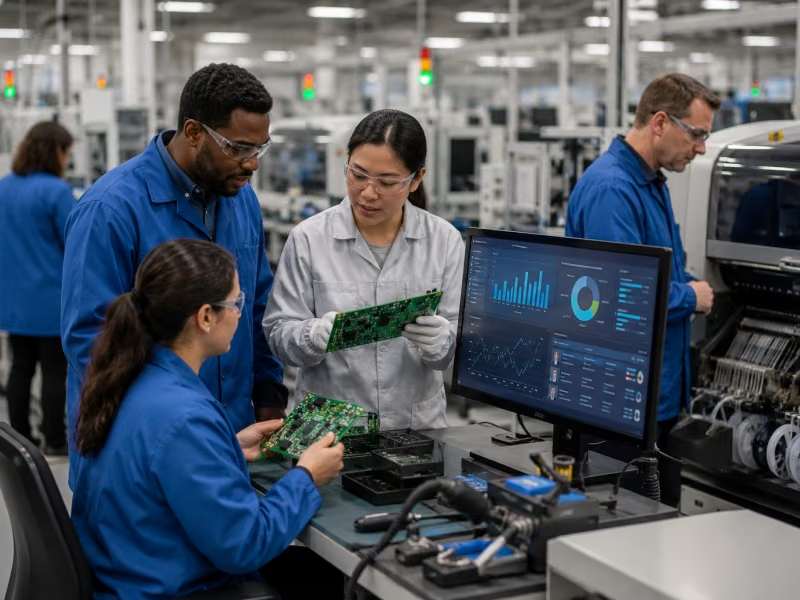
New federal and industry data point to cautious but improving hiring conditions across U.S. manufacturing, with electronics-related sectors showing signs of continued demand.
U.S. manufacturing employment edged higher in June, offering a modest but important signal for electronics employers watching the hiring market closely. The Bureau of Labor Statistics reported that manufacturing added 3,000 jobs during the month, while total nonfarm payroll employment increased by 57,000.
For electronics manufacturing, the picture was mixed but encouraging in key areas. BLS data showed computer and electronic product manufacturing added 1,500 jobs in June. Electrical equipment, appliance, and component manufacturing also added 1,500 jobs, while semiconductor and other electronic component manufacturing declined slightly.
The Institute for Supply Management’s June Manufacturing PMI report reinforced that cautious tone. Manufacturing activity expanded for the sixth straight month, and electrical equipment, appliances, and components was one of the industries reporting employment growth. ISM’s overall manufacturing employment index remained below expansion territory, but it improved from May.
That matters for employers because hiring conditions appear to be shifting from broad caution toward more targeted recruitment. Companies may not be adding headcount aggressively across every function, but production demand, customer inventory gaps, and new orders in electronics-related categories suggest continued need for skilled technicians, assemblers, quality workers, maintenance talent, and frontline supervisors.
For workforce partners, the takeaway is practical: training programs should stay closely aligned with real hiring signals from local employers. Short-term hiring may remain uneven, but electronics manufacturers still need workers who can step into roles involving precision assembly, inspection, testing, equipment operation, and production problem-solving.
The June data does not point to a hiring boom. It does point to a labor market where employers are still making selective additions, especially in parts of manufacturing tied to electronics, electrical equipment, and advanced industrial supply chains. For the electronics workforce, that means recruitment and training efforts should stay active, targeted, and ready for demand to strengthen.
Source note
Main sources: the U.S. Bureau of Labor Statistics June 2026 Employment Situation(Opens in a new tab/window), BLS Table B-1 industry employment detail(Opens in a new tab/window), the June 2026 ISM Manufacturing PMI report(Opens in a new tab/window), and Manufacturing Dive’s summary of June manufacturing jobs data(Opens in a new tab/window).